The diver's knowledge, experience and determination were never the limitation. Human physiology was.
For more than half a century, marine diamond recovery has relied upon the knowledge, skill and determination of commercial divers working in one of the world's most demanding environments. Their experience has built an extraordinary industry and recovered millions of carats from the seabed.
Yet throughout that history, one fundamental limitation has remained unchanged.
The diver's knowledge was never the limitation. The human body was.
THE REALITY OF HUMAN DIVING
Every dive is governed by physiological limits. As water depth increases, productive bottom time decreases. Decompression requirements increase. Fatigue becomes a factor. Weather windows shorten productive days, and every recovery operation must work within strict safety limits.
These constraints are unavoidable. They have shaped marine diamond production for decades and continue to influence the way underwater recovery is carried out today.
"Experience has never been the limitation. Time at the seabed has."
THE HIDDEN OPPORTUNITY BENEATH THE SAND
For decades, divers naturally concentrated on exposed diamond-bearing gravels lying between reefs and rock outcrops. These areas were visible, accessible and could be worked within the limited time available on the seabed.
Yet the vast majority of diamond-bearing gravels remain buried beneath layers of marine sand. Whether the sand cover is 150 mm or several metres thick, the gravel beneath remains hidden until the sand is removed.
HOW DIVERS CREATED ACCESS
To expose these hidden gravels, divers initially relied on suction to remove the overlying sand. It was a labour-intensive and time-consuming process, often taking many hours simply to open a small window to determine whether diamond-bearing gravels lay beneath.
I subsequently developed sand-blowing techniques using the vessel's propeller wash. Thirty minutes of effective sand blowing could achieve what previously required up to eight hours of diver-operated suction. By directing high volumes of water towards the seabed, large volumes of sand could be displaced rapidly, revealing the hidden gravel beneath and dramatically accelerating the prospecting process.
Each blow created a circular crater. To enlarge the mining area, another crater was formed beside the first, gradually opening a working face. This process demanded patience, experience and considerable skill, but it remained slow.
However, sand blowing solved only the first part of the problem. It exposed the gravel but did not remove the sand from the mining area. Productive mining required the sand to be continuously excavated, transported away from the working face and deposited behind the mining area. That realisation became one of the fundamental design principles behind the GAMECHANGER system.
FROM CIRCULAR CRATERS TO CONTINUOUS MINING
GAMECHANGER changes this process completely.
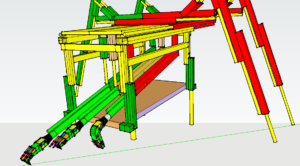
Instead of repeatedly creating isolated craters, the remotely operated mining system excavates a continuous working face through the sand while recovering diamond-bearing gravels at the same time
Operating continuously, day and night, the system is designed to maximise productive time during favourable weather windows while eliminating the physiological limitations that govern human diving operations.
"For the first time, the mining face—not the diver's endurance—becomes the limiting factor."
Every successful underwater diamond recovery system is governed by one principle: control the movement of water, and you control the movement of gravel. Master that relationship, and diamonds can be recovered efficiently. Fail to understand it, and production is lost.
UNDERSTANDING THE WORLD OF SUCK
Only a diver who has spent thousands of hours on the seabed truly understands it.
People often imagine marine diamond recovery as simply placing a suction hose on the seabed. The reality is completely different.
Every movement of the nozzle changes the flow of water, the behaviour of the gravel, and the movement of sand. A few centimetres can determine whether diamonds are recovered efficiently or washed away. Productive mining requires constant judgement, precision and experience.
After more than forty years recovering marine diamonds, I came to understand that successful underwater recovery is not about suction alone. It is about understanding how water, gravel, bedrock and hydraulic forces interact.
Thousands of hours spent working directly on the seabed taught me that successful underwater diamond recovery is not simply about suction. It is about understanding how water flow, gravel movement, bedrock and hydraulic forces interact before being covered by sand .
90 percent of existing available gravels are sand covered